Archive for May, 2009

Wetting and Spreading

Alright, I found it, the best title ever on a published paper. And it was published in Review of Modern Physics, a journal with an impact factor of 38, not any random journal.

Wetting and spreading

Daniel Bonn, Jens Eggers, Joseph Indekeu, Jacques Meunier and Etienne Rolley

Wetting phenomena are ubiquitous in nature and technology. A solid substrate exposed to the environment is almost invariably covered by a layer of fluid material. In this review, the surface forces that lead to wetting are considered, and the equilibrium surface coverage of a substrate in contact with a drop of liquid. Depending on the nature of the surface forces involved, different scenarios for wetting phase transitions are possible; recent progress allows us to relate the critical exponents directly to the nature of the surface forces which lead to the different wetting scenarios. Thermal fluctuation effects, which can be greatly enhanced for wetting of geometrically or chemically structured substrates, and are much stronger in colloidal suspensions, modify the adsorption singularities. Macroscopic descriptions and microscopic theories have been developed to understand and predict wetting behavior relevant to microfluidics and nanofluidics applications. Then the dynamics of wetting is examined. A drop, placed on a substrate which it wets, spreads out to form a film. Conversely, a nonwetted substrate previously covered by a film dewets upon an appropriate change of system parameters. The hydrodynamics of both wetting and dewetting is influenced by the presence of the three-phase contact line separating “wet” regions from those that are either dry or covered by a microscopic film only. Recent theoretical, experimental, and numerical progress in the description of moving contact line dynamics are reviewed, and its relation to the thermodynamics of wetting is explored. In addition, recent progress on rough surfaces is surveyed. The anchoring of contact lines and contact angle hysteresis are explored resulting from surface inhomogeneities. Further, new ways to mold wetting characteristics according to technological constraints are discussed, for example, the use of patterned surfaces, surfactants, or complex fluids.

Most of us live hoping we will get a paper published with a title this cool.

Comments (1)

Video Abstract: Quantum Stochastic Walks

Comments off

Quantum Stochastic Walks

We just posted a paper in the arXiv.

Quantum stochastic walks: A generalization of classical random walks and quantum walks

We introduce the quantum stochastic walk (QSW), which determines the evolution of generalized quantum mechanical walk on a graph that obeys a quantum stochastic equation of motion. Using an axiomatic approach, we specify the rules for all possible quantum, classical and quantum-stochastic transitions of a vertex as defined from its connectivity. We show how the family of possible QSW encompasses both the classical random walk (CRW) and the quantum walks (QW) as special cases, but also includes more general probability distributions. As an example, we study the QSW on the line, its QW to CRW transition and transitions to genearlized QSWs that go beyond the CRW and QW. QSWs provide a new framework to the study of quantum walks with environmental effects as well as quantum algorithms.

I promise a simple explanation of Classical Random Walks soon!

Comments off

What is Time-Dependent Density Functional Theory?

Time-Dependent Density Functional Theory looked like a mess when it was first explained to me. I probably made the face of a person who smells sushi for their first time, wondering if this is some sort of bad joke.

After all, quantum mechanics is supposed to be a theory of non-commuting observables that evolve in a linear fashion. TD-DFT is nothing like that, yet it claims to reproduce all the same effects. Fishy indeed.

TD-DFT first focuses on the density of the wave function, in particular, the position basis of it. This is relevant for chemical calculations where it is very important to know where are the electrons. Of course, the density is one of many observables that are relevant, but TD-DFT makes it stand out by letting this observable evolve by means of a functional of itself. In other words, you don’t fully evolve the wave function by means of an operator, but instead you have a very complicated, non-linear functional that takes as its input the density and lets it evolve. In practice, since the functional is non-linear, in practice, the evolution is done iteratively.

Runge and Gross proved that if you only cared about the evolution of one observable, the density, this procedure is equivalent to the full quantum mechanical evolution. In other words, you can map the evolution of a particular observable the wavefunction under Schrodinger’s equation into a functional of the same observable.

What you gain from this approach is a computational speedup. The prize paid is that writing the exact functional is actually a very hard problem, at least as hard as doing the full quantum mechanical evolution. However, in practice, approximated functional can be written down and used for real calculations that can predict properties for real materials. This technique is widely used, mostly as a black box toolkit used by many physical chemists around the world.

In our latest papers, we were able to show that this mapping can be also performed for open quantum systems instead of just Schrodinger’s equation. First, we developed the general theory of how the Runge-Gross theorem can be generalized, placing it in context of previous incomplete attempts. This paper was published in PCCP as a Hot Article. In it, we discuss how the theorem works even in the highly non-Markovian regime of an open quantum system.

In our second paper, we take this even further. The evolution of an observable of an open quantum system can be mapped to a functional for a close system. At first, this seemed counter-intuitive. After all, you cannot map the evolution of an open system into a closed system.

O te peinas o te haces rolos.

However, if you only care about one observable, and you are willing to use non-linear functionals, this can be done consistently, for just that observable. Since most of the code written for TD-DFT was for closed systems, our results shows that those techniques could be used to model open quantum systems. We feel that new chemical calculations with thermodynamic effects can now be explored with this theory.


Dr. Strangelove: It is not only possible, it is essential.

Comments off

Our paper chosen as PCCP Hot Article!

Our paper

Time-dependent current-density functional theory for generalized open quantum system

Joel Yuen-Zhou, César Rodríguez-Rosario and Alán Aspuru-Guzik


In this article, we prove the one-to-one correspondence between vector potentials and particle and current densities in the context of master equations with arbitrary memory kernels, therefore extending time-dependent current-density functional theory (TD-CDFT) to the domain of generalized many-body open quantum systems (OQS). We also analyse the issue of A-representability for the Kohn–Sham (KS) scheme proposed by DAgosta and Di Ventra for Markovian OQS [Phys. Rev. Lett. 2007, 98, 226403] and discuss its domain of validity. We suggest ways to expand their scheme, but also propose a novel KS scheme where the auxiliary system is both closed and non-interacting. This scheme is tested numerically with a model system, and several considerations for the future development of functionals are indicated. Our results formalize the possibility of practising TD-CDFT in OQS, hence expanding the applicability of the theory to non-Hamiltonian evolutions.
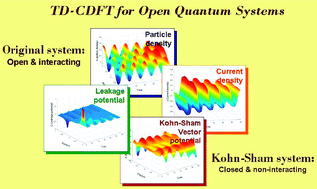
TD-CDFT and Open Quantum Systems

TD-CDFT and Open Quantum Systems

has been published on PCCP and chosen as a Hot Article !

Comments off